




By Ken Jones, Owner at Flamingo Custom Carts
Published
The best golf cart speakers are weather-resistant, mounted where the sound reaches riders without blasting the neighbors, and wired through a proper voltage converter and fuse. Start with outdoor- or marine-rated parts, choose a mounting location that fits your roof and seats, and plan the power side before you plan the playlist.
Here is how to think through a sound setup that sounds good and holds up season after season.
Why Golf Cart Speakers Need to Be Weather-Ready
A golf cart is an open vehicle. Your audio gear will see sun, humidity, pollen, dust, rain blowing in under the roof, and morning dew. Standard car audio parts are built for the inside of a closed cabin and may not hold up to that exposure.
That is why many owners choose marine speakers or other outdoor-rated audio gear. Parts built for boats are designed with water and sun exposure in mind, using materials and seals meant for wet, bright environments.
Reading an IP Rating
Some audio products list an IP rating. The IP Code comes from the international standard IEC 60529, which classifies the degrees of protection an enclosure provides. The first digit covers solid objects such as dust, and the second digit covers water.
According to E-T-A’s guide to degrees of protection, a second digit of 4 means splashed water from any direction should have no harmful effect, 5 covers water jets, 6 covers powerful water jets, and 7 covers temporary immersion. When you compare golf cart speakers, a stated rating gives you something concrete to compare.
Where to Mount Golf Cart Speakers
Mounting location affects sound quality, protection from weather and how the cart looks. Most setups use one or more of these spots.
Roof or Overhead Console
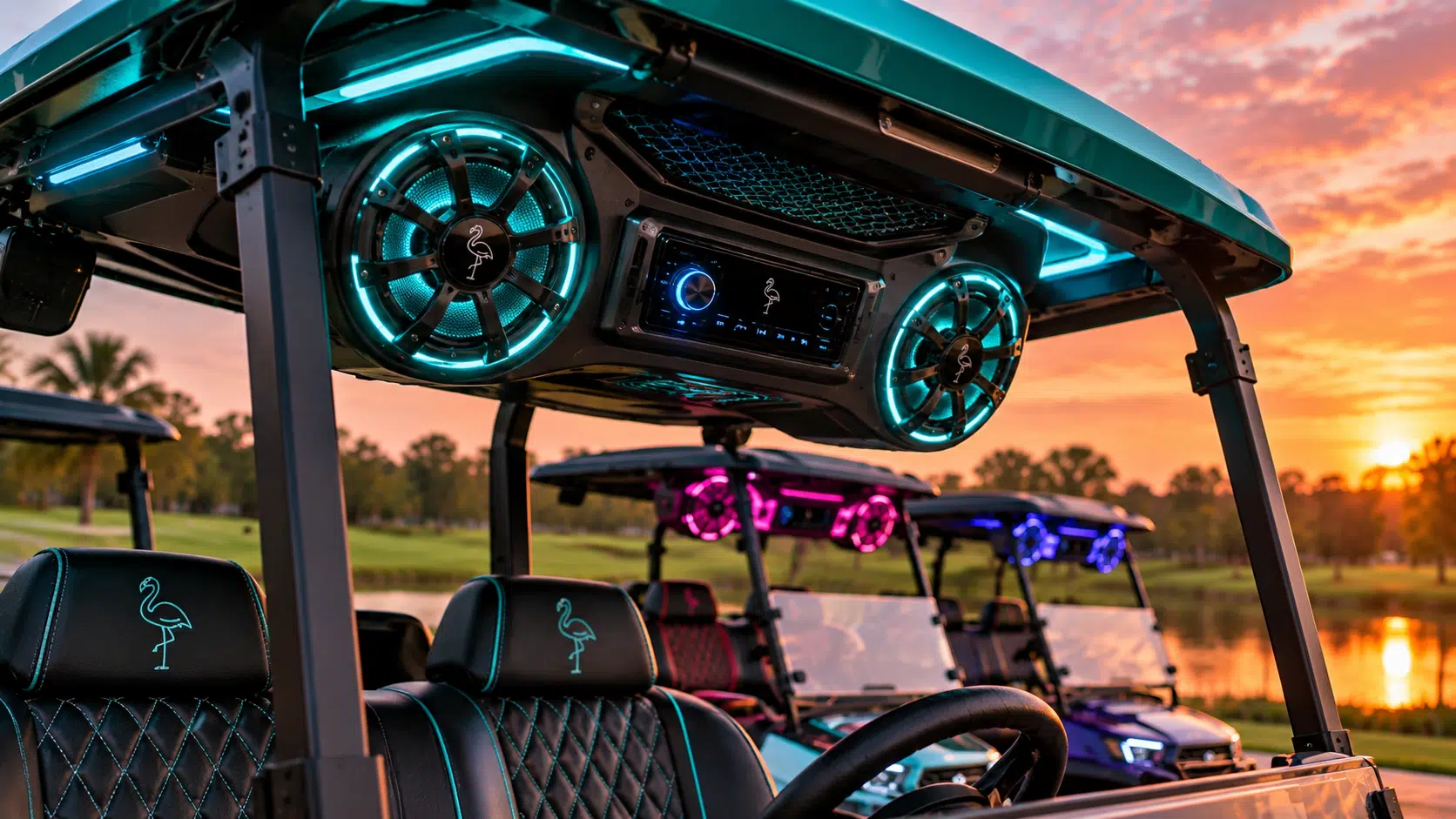
An overhead console mounts under the roof and can hold speakers, a head unit and sometimes lighting controls. Sound comes from above the riders, and the roof shields the console from direct rain and sun. Check that the console is made for your roof style.
Under the Seat
Speakers mounted in or under the front seat base sit close to riders and stay mostly out of the weather. Space is limited, and that area may be near batteries or wiring on some carts, so the installation needs to keep everything clear and secure.
Soundbar
A golf cart soundbar mounts as a single unit, often to the roof supports. It packs several speakers into one housing, which keeps wiring simpler and gives a clean look. Make sure the mount fits your cart’s struts and that the bar does not block the driver’s view.
Powering a Golf Cart Sound System Safely
Power is the part of a sound install people most often get wrong. Many electric golf carts run on a battery pack with a higher voltage than the 12 volts most accessory audio gear expects. Check your owner’s manual for your cart’s system voltage.
Installers commonly use a voltage reducer, also called a DC-to-DC converter, to step pack voltage down to 12 volts for accessories. The converter must be sized to handle everything connected to it, including lights, speakers and any amplifier.
- Fuse every power feed. A correctly sized inline fuse near the power source protects the wiring if something shorts.
- Use the right wire gauge. Wire that is too thin for the current can overheat.
- Route wires away from moving parts and sharp edges. Use grommets where wires pass through panels.
- Keep connections dry. Weatherproof connectors and protected splices help prevent corrosion.
- Mind the power draw. Audio uses energy from the same pack that moves the cart, so a bigger system can affect how far you go between charges.
If you run a lithium pack, good charging habits matter even more once you add accessories. Our guide to lithium golf cart battery charging covers the basics.

7 Helpful Tips for Choosing Golf Cart Speakers
Use these seven tips to plan a golf cart sound system that fits your cart, your budget and your neighborhood.
- Start with weather resistance. Look for marine speakers or outdoor-rated parts, and compare stated IP ratings where they are listed.
- Pick the mounting spot first. Roof console, under-seat and soundbar setups each need different hardware, so decide on placement before choosing speakers.
- Match speakers to the source. Your head unit or amplifier should be able to drive the speakers you choose. Check the power ratings on both spec sheets.
- Plan the power path. Use a properly sized voltage converter, fuse each feed and use wire rated for the load.
- Think about Bluetooth and controls. Decide whether you want a head unit with physical controls, a Bluetooth receiver, or both, and where the controls will sit.
- Keep the look clean. Hidden wiring and matched finishes make golf cart speakers look like part of the build, not an add-on.
- Plan for courtesy volume. Choose a setup that sounds good at moderate volume, so you are not tempted to turn it up in quiet areas.
Volume Courtesy in Neighborhoods
Open carts carry sound a long way, especially at night and in quiet subdivisions. Keep volume moderate near homes, pools, golf courses and community areas, and turn it down when you pass people walking.
Many cities, counties and homeowners associations have noise rules. Check with your city, county or HOA about local limits; this is general information, not legal advice.
A good golf cart sound system is about clarity, not maximum volume. Speakers placed close to the riders let you hear your music at lower levels, which keeps everyone around you happier.
Caring for Golf Cart Speakers Over Time
Even weather-resistant gear lasts longer with a little attention. A few simple habits keep golf cart speakers sounding clear and help you catch small problems early.
- Wipe, do not blast. Clean grilles and housings with a damp cloth instead of spraying water straight at them, and never aim a pressure washer at speakers or wiring.
- Check mounts and hardware. Vibration from bumpy paths can loosen screws and brackets over time, so look them over every so often.
- Look at connections. Green or white crust on terminals is a sign of corrosion. Have it cleaned up before it causes cutouts or shorts.
- Listen for changes. Rattles, crackling or one side going quiet usually point to a loose connection or a damaged speaker.
- Cover the cart when parked outside. A cover keeps sun, pollen and rain off the console, controls and speaker faces.
If any part of the system stops working, turn it off and have the wiring checked before using it again. A shorted wire on a cart’s electrical system is not something to ignore.

Frequently Asked Questions
Do I need marine speakers for a golf cart?
Not always, but outdoor- or marine-rated speakers are built for moisture and sun exposure that an open cart sees every day. They are a sensible choice for most owners.
Will golf cart speakers drain my battery?
Audio draws power from the same pack that drives the cart. A modest system has a smaller effect than a large one with amplifiers. How much it affects range depends on your system, your volume and your battery.
Can I wire speakers straight to the battery pack?
Most accessory audio gear is designed for 12 volts. If your cart’s pack runs at a higher voltage, a properly sized voltage converter and fuse are needed. Check your owner’s manual and have the work done by someone experienced with cart electrical systems.
Is a soundbar better than separate speakers?
A soundbar is simpler to mount and wire, while separate speakers give you more placement options. The better choice depends on your roof, your seats and the look you want.
Build Your Golf Cart Speakers Setup With Flamingo Custom Carts
Flamingo Custom Carts, the custom build and upgrade shop of Golf Carts Atlanta, designs and installs custom sound systems that fit with the rest of your build. See our custom sound systems page, or visit us at 1680 Lower Roswell Rd, Suite 100, Marietta, GA 30068, Monday through Friday from 7am to 3pm.
Call (678) 436-2282 or contact us online to plan speakers, mounting and wiring for your cart.